
Home>Running Events>Free Sports Icons for Running Clubs and Race Event Websites
Running Events
Free Sports Icons for Running Clubs and Race Event Websites
Published: August 19, 2026
Running club admins and race directors can find free, scalable sports icons for websites and event graphics, no licensing fees required.
Free Sports Icons for Running Clubs and Race Event Websites
Designing a race website on a tight budget is a real balancing act. You want it to look sharp, load fast, and feel professional, but hiring a graphic designer for every icon and illustration is not realistic when registration fees are already covering chip timing and t-shirts. The good news is that high-quality, web-ready visual assets are out there, and many of them cost absolutely nothing.
Key Takeaway:
1. Free SVG icon libraries give running clubs and race directors scalable, professional-looking graphics with zero licensing cost.
2. SVG files stay crisp at any size, making them ideal for everything from a favicon to a finish-line banner mockup.
3. For social media captions and messaging, emoji are a lighter-weight complement that audiences already recognize and engage with.
Why Visuals Matter More Than You Think
A race registration page is often the first thing a potential participant sees. Before they read the course description or check the date, they are scanning the page visually. A clean, well-structured design tells them that the event is organized and worth their entry fee.
Icons do a lot of the heavy lifting here. They break up dense text, point people toward important information, and give the page a sense of polish that plain text simply cannot. The same logic applies to your club’s homepage, your volunteer signup form, and even the email you send out the week before race day.
The problem is that most premium icon sets charge per seat, per project, or per year. For a volunteer-run club with a budget measured in hundreds of dollars, that kind of ongoing cost is hard to justify.
What Makes SVG the Right Format for Running Events
Not all icon formats are equal. JPEG and PNG files are fine for photographs, but they blur when you scale them up. Drop a PNG icon into a banner at twice its intended size and you will see exactly what that means.
Scalable Vector Graphics, or SVG, works differently. The format stores shapes as mathematical instructions rather than pixels, which means an SVG icon looks just as sharp on a phone screen as it does printed on a poster. For race directors who need to reuse assets across a registration site, a PDF course map, and a social media header, that flexibility is genuinely useful.
SVG files are also small. A well-optimized icon might weigh in at a few kilobytes, which keeps your site loading fast even when you have a lot of them on the page. Page speed matters for registration conversion, and it matters for search rankings too.
Where to Find Free Sports Icons That Actually Look Good
The hard part used to be finding icons that were both free and professionally designed. Clip art from the early web era still haunts a lot of volunteer-built sites, and it shows.
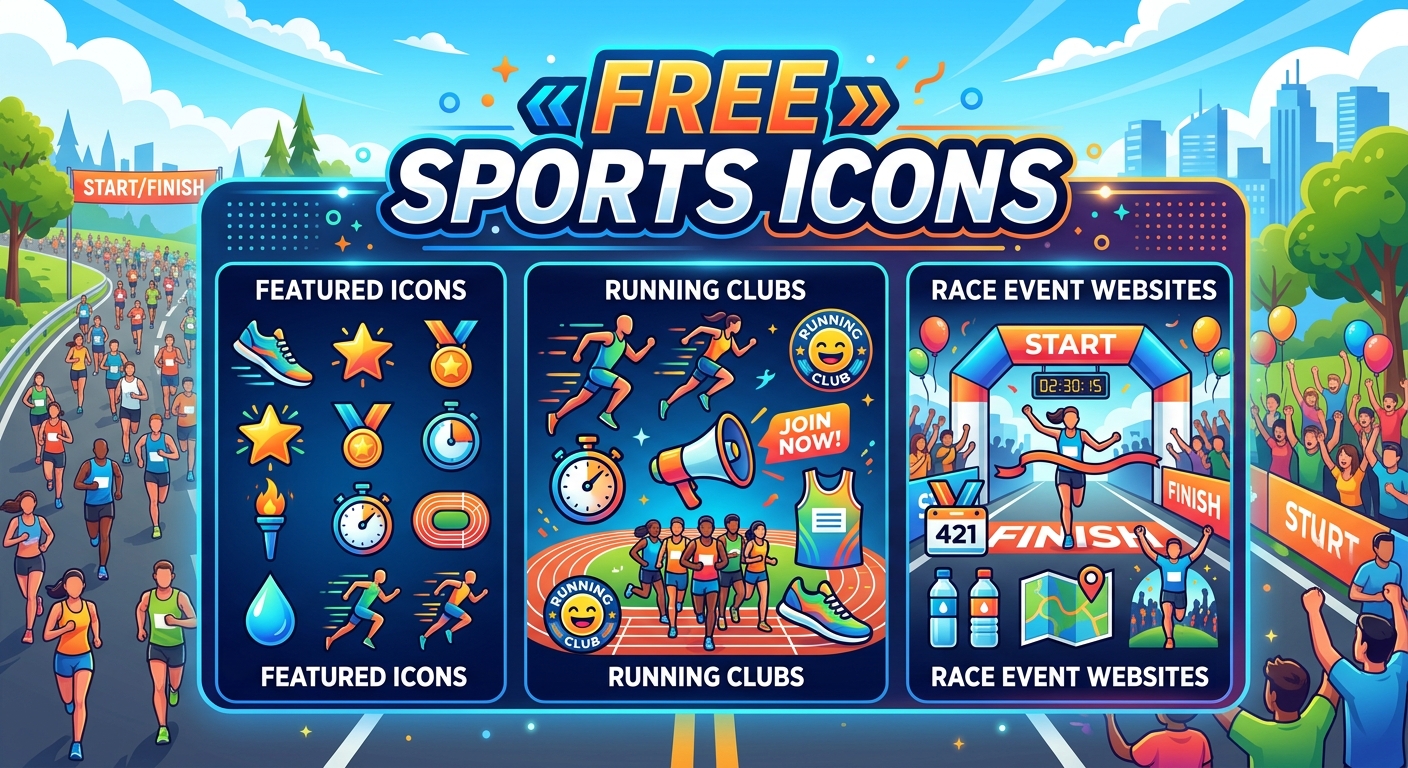
A curated library of sports icons solves this in one place. The collection covers running, cycling, swimming, and dozens of other athletic categories, all drawn in a consistent style so they look like they belong together on the same page. You can drop them straight into a web project without touching an image editor.
Consistency is the thing most amateur-designed sites miss. When icons from three different sets with three different visual weights appear on the same page, the overall effect feels cobbled together. A single source with a unified style avoids that problem entirely.
How to Put These Icons to Work on Your Site
The practical applications are wider than most people initially assume. Here are some of the ways running clubs and race directors actually use icon sets like this:
- Registration page headers, to mark sections like “Course Details,” “Packet Pickup,” and “Timing”
- Category markers for age group divisions
- Navigation icons for mobile-friendly menus
- Sponsor page decoration to make a text-heavy section feel less dense
- Volunteer signup forms, where icons help people quickly identify roles
- Email headers for race-week communications
Most website builders, including WordPress, Squarespace, and Wix, accept SVG uploads directly. If your builder does not, a quick conversion to PNG at the size you need is straightforward and free.
The Social Media Side of the Picture
Your race website is just one piece of the communication puzzle. Instagram posts, Facebook event pages, and text message updates to registered runners all need a visual language too.
This is where full SVG icons are not always the right tool. Social platforms compress and resize images in unpredictable ways, and a vector illustration that looks perfect on your site might appear muddy in an Instagram story or get cropped oddly in a tweet.
Emoji fill this gap naturally. They render crisply across every platform because they are baked into the operating system rather than loaded as external images. A well-placed running shoe or finish flag in a caption catches the eye without any design work at all. Browsing a full activities emojis reference gives you a searchable catalog of options, organized by category, so you can find the right symbol for a race countdown post or a training tip without guessing at keyboard shortcuts.
Licensing: The Detail You Cannot Afford to Skip
Free does not always mean free to use commercially. Some icon libraries are released under Creative Commons licenses that require attribution, others restrict commercial use, and a handful are genuinely open with no strings attached.
Before you build a race brand around any icon set, check the license. For most volunteer-run clubs and small community races, attribution licenses are fine as long as you include a credit line somewhere on the site. For larger commercial events with sponsors, a fully free license is worth seeking out specifically.
The library linked above is designed for web use without licensing headaches, which is part of what makes it practical for race directors who are already managing a hundred other details.
Getting the Most Out of Free Assets
A few practical habits will help you get better results from free icon libraries:
Start with a style guide. Pick two or three icons that represent your event’s personality, and use them consistently across every touchpoint. A trail race and a city marathon will want different visual tones even if they both use the same library.
Size your icons intentionally. SVGs scale without quality loss, but that does not mean any size is a good size. Icons used for navigation should generally be smaller than icons used as section headers. A consistent sizing system makes the page feel organized.
Pair icons with labels. Research on web usability, including studies from usability.gov on how users scan pages, consistently shows that icons paired with text outperform standalone icons in comprehension. Do not assume a runner silhouette needs no label.
Export what you need. Some builders work better with PNG than SVG. Export icons at double the display size (a technique called 2x exporting) so they stay sharp on high-resolution screens.
Icons You Can Actually Use, Starting Today
Running clubs and race directors have enough on their plates without spending hours hunting down design assets. A solid free icon library solves a real problem, and it solves it in a way that scales with your event as it grows.
Start small. Pick five or six icons that match your core event categories and drop them onto your registration page. See how they change the feel of the layout. Then branch out into email headers, social graphics, and whatever else your promotional calendar demands.
The visual identity you build this season will carry forward to next season too. A consistent look across a few years of race materials turns a one-off event into something people recognize and trust. That kind of brand recognition is worth far more than any icon ever cost.