Home>Running Culture>Culture>What Emojis Really Do for a Runner’s Social Media Presence
Culture
What Emojis Really Do for a Runner’s Social Media Presence
Published: September 1, 2026
The right emoji in a running post drives real engagement. Here's why running communities use them in Strava comments, race captions, and group chat hype threads.
A five-character caption with one well-chosen emoji can out-perform a paragraph of race-day prose. That’s not a guess, it’s what you see every time you scroll through Strava or check the group chat after a hard tempo run. The right symbol catches the eye, signals effort, and instantly tells other runners what kind of post this is before they read a single word. And for a community that communicates in split times and suffer-faces, that shortcut matters more than most people realize.
Key Takeaway:
– Emojis in running posts improve engagement by adding emotional context that text alone cannot match.
– The running community uses them heavily in Strava comments, group chat hype threads, and race-day captions.
– Choosing icons that render clearly on small mobile screens makes all the difference in how posts land.
– Pre-race motivation strings are a copy-paste ritual among coaches and athletes before big events.
– Knowing where to find running-specific icons saves time and keeps posts feeling intentional, not random.
Why a Single Symbol Changes Everything
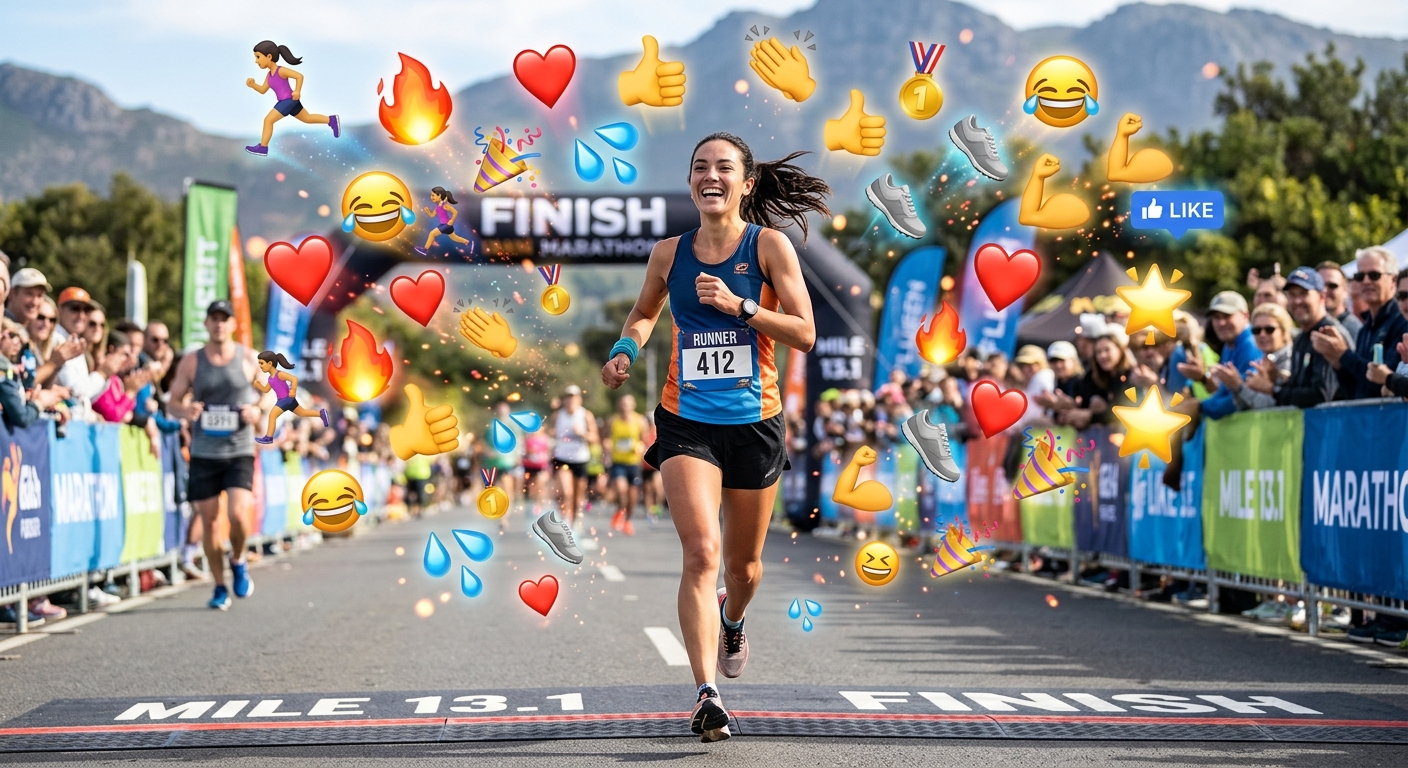
Most runners who post consistently will tell you the same thing: the posts that perform best are rarely the longest ones. They’re the ones with a clear hook, a sharp image, and at least one emoji that does emotional heavy lifting. A fire symbol next to a PR time reads as celebration and intensity at once. A running figure next to a finish-line time signals accomplishment without a single descriptive word. A sweating face after a long effort says “this hurt” before the reader processes anything else.
This works because the brain processes visual cues faster than text. Before a reader decides whether to stop and engage, they’ve already scanned for signals. An emoji functions as a mood tag, telling the audience what emotional register the post is operating in before they commit to reading it.
As a communication format, emoji was first developed in Japan in the late 1990s specifically to add emotional nuance to short-form digital messages. What started as a practical workaround for plain-text limitations became global shorthand for tone. Runners, like every other digital community, adapted it to their own culture and vocabulary over time.
The Difference Between Posts That Land and Posts That Disappear
Not every running post needs to go viral. But most runners do want their content to land, whether that’s a comment from a training partner or a kudos spike on Strava. Emojis help that happen in ways that are easy to overlook until you start paying attention to the pattern.
Think about how you skim your feed after a race weekend. You’re not reading every caption front to back. You’re catching signals. A post that opens with a race-flag emoji, a finish time, and a face showing pure exhaustion tells you exactly what happened before you read anything. You stop. You engage. That’s the mechanic.
The posts that don’t travel usually share one trait: they lead with text. A three-sentence caption explaining how the race went is useful, but it doesn’t stop a fast-scrolling thumb. Pairing those sentences with the right symbol does.
How Emoji Placement Affects Running Post Performance
| Post Format | Visual Hook | Emotional Signal | Typical Engagement |
|---|---|---|---|
| Text only | None | Depends on reading | Reader must invest time |
| Emoji at start | Strong | Set before first word | Highest stop-rate |
| Emoji mid-caption | Moderate | Mixed with surrounding text | Context-dependent |
| Emoji string at end | Weak | Trailing afterthought | Often ignored |
| Strategic single emoji | Very strong | Precise and intentional | Consistent engagement |
Placement matters as much as the choice itself. One well-placed emoji at the very start of a caption signals what the post is about before the reader processes any text. Trailing strings of five or six icons after a long paragraph tend to be scrolled past because by then the reader has already made their decision.
How Strava Turned Emojis Into a Running Dialect
Strava has its own culture, and emojis are woven into it in ways that feel native to the sport. When a club member drops a suffering face on a brutal hill repeat session, that’s not decoration. It’s acknowledgment. It’s saying “I see what you did, I know how that felt, and I’m with you.”
The same dynamic plays out in group chats before long training blocks or race weekends. Someone posts a route preview and within seconds the replies are filled with focused faces, lightning bolts, and raised fists. These aren’t random. Experienced runners in close groups develop shared emoji vocabulary over months and years of training together.
This makes emoji fluency a real social skill inside running communities. Using the right ones signals that you understand the culture. Using the wrong ones, or none at all, makes posts feel stiff and disconnected from the people you’re trying to reach.
Finding Running Icons That Actually Read on Mobile
The practical problem most runners run into is a simple one: the emoji keyboard on a phone contains hundreds of options, and not all of them read well at thumbnail size. Some icons look fine on a desktop browser but turn into indistinguishable blobs on a phone screen. That’s a genuine issue for posts meant to be consumed on mobile, which covers the vast majority of running content.
Having a curated reference pays off here. Browsing through sports emojis gives you a filtered view of running and fitness-related icons, organized so you can see how each one renders across different sizes and platforms. Instead of scrolling through the full keyboard and guessing, you get a practical shortlist of icons that are clear, relevant, and mobile-readable.
For running content specifically, the icons worth knowing include the running figure, the trophy, the stopwatch, the mountain for trail runners, the fire, the lightning bolt, and the various faces that cover everything from determination to post-race collapse. Each one carries a specific meaning in running culture. Using them intentionally, rather than decoratively, is what separates posts that resonate from posts that vanish.
Pre-Race Strings and the Group Chat Hype Ritual
Any runner who has been part of a serious training group knows the pre-race ritual in the group chat. The night before a big event, or the morning of, someone fires off a hype message. It usually starts with a few charged words and trails into a string of emojis that land like a drumroll before the starting gun. And it works. It raises the energy level of everyone reading it in a way that plain text simply does not.
Coaches use this too. A pre-race message that ends with the right combination of symbols carries a different emotional weight than one that ends with a period. The symbols amplify the intent. They signal: this is a serious moment, and we are in it together.
For anyone who wants to put together these strings without overthinking them, browsing motivation combos offers curated sets that coaches and athletes copy-paste into group messages before races and hard training days. The combinations are built around emotional arcs, moving from focus to effort to victory in a sequence that reads naturally rather than feeling thrown together.
Building a Better Running Caption From the First Word
If you want more consistent results from your running posts, the method is straightforward. Here is a process that works regardless of whether you are posting a race recap, a morning run, or a mid-training update.
- Decide what single emotion you want to lead with before you write a single word. Suffering? Pride? Relief? Determination? Pick one and stay there.
- Find one emoji that captures that emotion clearly. Not three. Not five. One.
- Open your caption with it, before any text at all.
- Write the caption itself in plain language. Short sentences. No explaining what the emoji already said.
- Add one more emoji at the end only if it genuinely reinforces the closing message, not as filler.
- Read it back at arm’s length on your phone. If the emoji and the words are saying the same thing, the post is ready.
This approach keeps posts from feeling cluttered. It also forces a real decision about what the post is actually about, which tends to improve the writing alongside the visual presentation.
What Emoji Fluency Actually Looks Like in a Running Feed
A runner who has figured out emoji fluency does not use them on every post. They use them on the right posts. A training recap that needs emotional weight gets one strong icon placed deliberately. A light note about a recovery jog might not need any. A race-day post almost always benefits from one, placed at the very start.
The runners with the most engaging feeds tend to treat emojis the same way they treat word choice: intentionally and sparingly. Each one earns its place. Nothing is decorative. Nothing is reflexive. Nothing is there just to fill space at the end of a sentence that ran out of things to say.
That standard is higher than most people set for themselves, but it is achievable. And the results show up in the way posts land, the comments they attract, and the way a running community responds when the signal is clean and clear.
When the Right Emoji Crosses the Finish Line
Running has always been a sport where communication matters. You talk pace on group runs. You share suffering with strangers at mile 20. You hype each other up in the starting corral before a race. Social media is just another version of that conversation, and emojis are the shorthand that makes it work at the speed of a scrolling thumb.
Using them well does not require a background in marketing or any deep knowledge of algorithms. It requires the same thing running does: paying attention to detail, making intentional choices, and knowing your audience. Your audience is runners. They read these symbols the way they read split times. They know exactly what you mean when you use them right.
Get the emoji right, and the post takes care of itself.