Home>Health and Wellness>Health>The Overlooked Connection Between Athletic Training and Typing Speed
Health
The Overlooked Connection Between Athletic Training and Typing Speed
Published: August 6, 2026
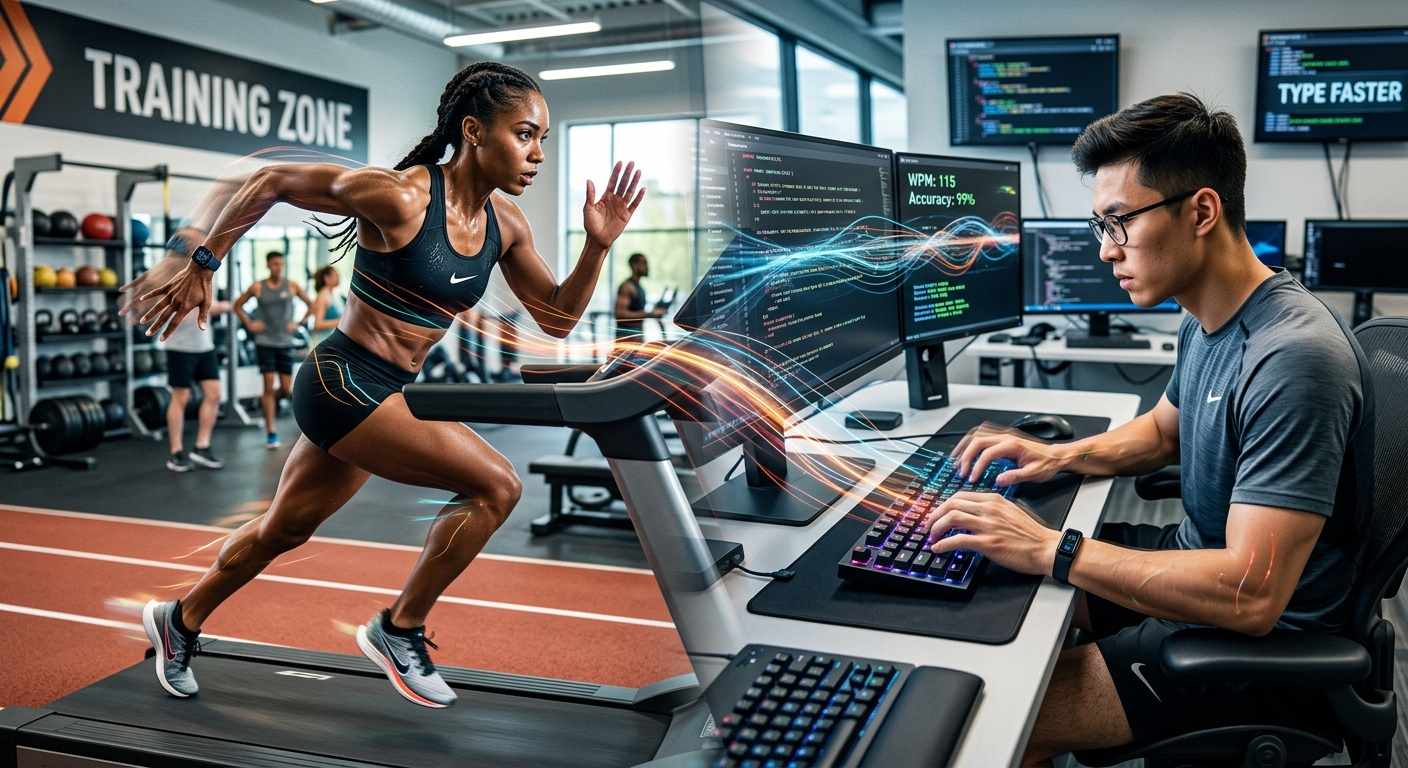
Runners already know that benchmarks and deliberate drills build performance. That same logic applies directly to your typing speed at the desk.
If you lace up your shoes before sunrise to log miles, you already understand something most people never figure out: performance improves through structure, not wishful thinking. You track splits. You run intervals. You measure progress and adjust. Now consider your keyboard. Most people type the same way they always have, with no benchmark, no drill, no feedback loop. For runners who also spend hours at a desk, that gap is worth closing.
The discipline that builds faster runners also builds faster typists.
– Timing yourself creates a baseline, just like a timed mile sets your starting point for a training block
– Deliberate finger-placement practice mirrors the form drills you slot between long runs
– Small, consistent sessions compound into real speed gains across weeks, not months
Your Desk Is a Second Performance Arena
Most runners treat work performance as entirely separate from physical training. But the overlap is real. Both domains reward repetition with measurable outcomes. Both punish sloppy form over time. A runner who never checks their pace never knows if they’re improving. A typist who never benchmarks their speed is in exactly the same position.
The average office worker types for six or more hours a day. At 40 words per minute, that’s a considerable volume of keystrokes. At 70 or 80 words per minute, the same workload demands significantly less cognitive overhead per task. The efficiency gain compounds across years. It’s the typing equivalent of shaving two minutes off a 5K, except you benefit from it every single workday.
Why the Athletic Training Mindset Works Here
Athletes know that unstructured effort produces inconsistent results. A runner who just goes out and runs whenever they feel like it rarely improves. The same applies to keyboard skills. Typing every day at work is not the same as training. It’s the equivalent of walking to the mailbox and calling it cross-training.
Research into motor learning confirms that skill acquisition follows a predictable pattern: early gains come fast, plateaus appear, and only deliberate targeted practice breaks through them. Runners hit this wall around the same time they stop varying their workouts. Typists hit it the moment they stop paying attention to their hands entirely.
The fix is the same in both cases. You need a structured drill, honest measurement, and a feedback loop that gives you real numbers.
Benchmark First, Train Second
No runner starts an interval program without knowing their current pace. You need a number to improve on. The same logic applies here. Before you do anything else, get a real number on record.
A 1 minute typing test gives you that baseline in under 60 seconds. It works like a timed mile. You type, the clock runs, and you get an immediate WPM score when you finish. No guesswork, no self-reporting, just a number that tells you exactly where you stand.
That score becomes your starting line. You write it down, you come back to it, and you try to beat it. This is not a trivial exercise. Many people who consider themselves decent typists discover they’re sitting in the low 40s. Others are surprised to find they’re already at 65 or 70. Either way, the number gives you something concrete to act on. Runners know that feeling well.
The Form Problem Nobody Talks About
Here’s where runners have a distinct advantage. They already know that raw effort without correct form creates a ceiling. You can push your pace harder, but if your gait is wrong, injury or stagnation follows. Typing has the same problem, and most people never address it.
The majority of self-taught typists use a hybrid approach: a few correct fingers, a few improvised ones, muscle memory layered on top of bad habits. It works well enough for most tasks, but it puts a hard cap on speed. The fingers doing extra work fatigue faster. Accuracy drops under pressure. For many people who never corrected their form, the ceiling sits right around 50 to 60 WPM.
Touch typing practice addresses this the same way form drills address running mechanics. You slow down deliberately. You focus on finger placement. You rebuild the movement pattern from the foundation up, even if it feels slower at first.
Runners who have fixed their stride know this discomfort. The new form feels awkward before it feels natural. That is not a sign something is wrong. It is a sign you are actually changing something.
According to the overview of touch typing technique, trained typists who use all ten fingers with proper home-row positioning consistently outperform those using improvised techniques, especially as document length and task complexity increase. The gains are structural, not just habitual.
How to Structure a Typing Training Block
Think of this as adding a second training block to your week. It does not need to be long. Runners do not do long runs every single day. The same principle applies here.
A practical weekly structure looks like this:
- Three short sessions per week, 10 to 15 minutes each, focused on deliberate finger-placement drills that prioritize accuracy over speed
- One timed benchmark at the end of the week to track progress against your starting score and spot which keys are slowing you down most
That is it. The benchmark keeps you honest. The drills build the underlying skill. The rest of the time, you type normally. Over four to six weeks, most people who stick to this structure see measurable improvement. That timeline should feel familiar to anyone who has run a training cycle.
The Psychology of the Short Test
There is a reason interval training is psychologically easier than long slow distance for many runners. The effort is finite. You know it ends. You can give full focus for a short burst without dreading an endless slog.
The same psychology works for typing practice. A session that extends past 20 minutes tends to produce fatigue and distraction. Accuracy drops. The training value decreases. Short, focused, repeatable, that is the formula.
This is why a sub-60-second baseline test is a better starting tool than a 10-minute typing marathon. You can take it seriously for under a minute, get a real number, and move on. Runners who warm up with a timed 400 meters already understand the value of the short, honest effort.
What Progress Actually Looks Like
Progress in typing speed is not linear, and that should feel familiar too. Runners do not improve their pace by the same amount every week. There are weeks where the numbers stall, and then a week where everything clicks and the splits drop.
Typing improvement follows the same curve. Early sessions often show rapid gains as better form replaces bad habits. Then a plateau sets in while the new movement patterns consolidate. Then another jump. The athletes who stay consistent through the plateau are the ones who eventually see real change.
A few markers to watch for as you build:
- Accuracy improving before speed, which signals that form is genuinely correcting rather than just pace temporarily dropping
- Less fatigue in your hands and forearms during long work sessions, especially in the afternoon
- Fewer backspace corrections during normal typing tasks, which saves more time than raw WPM suggests
- Your benchmark score moving upward by 5 to 10 WPM over four to six weeks of consistent short sessions
When Runners Clock in at Their Desks
There is a specific kind of person who gets the most out of this framing. It is the runner who takes training seriously, hits their weekly mileage goals, tracks GPS data after every run, and then sits down at a desk job and completely ignores performance principles for the next eight hours.
That contrast does not have to be the default. The habits that make someone a disciplined runner, honest self-assessment, structured effort, form work, patience through plateaus, transfer directly to keyboard skills. The domain is different. The method is identical.
If you have already built the discipline to get out of bed at 5am for a tempo run, you already have everything it takes to sit down for a 10-minute drill three times a week. The barrier is not motivation. It is the recognition that the desk is worth training for at all.
The Finish Line Is a Faster Workday
Runners train so races feel easier and results improve. The goal at the desk is identical: less friction, more output, less fatigue by 4pm. A typist working at 75 WPM with high accuracy finishes written tasks faster, responds to messages without the small cognitive overhead of slow keystrokes, and ends the workday with more mental energy intact.
That matters. Not because typing speed is glamorous, but because cognitive fatigue is real and compound effects are real. The hours you spend at a keyboard are not a neutral backdrop to your work. They either support your output or create small, consistent drag on it, day after day.
You already know how to train. You already know that benchmarks matter, that form beats brute force, and that consistent short efforts compound into meaningful gains. The only step left is applying that knowledge somewhere most runners have never thought to look.